It's been a while since I last posted something here, but it's also been a very eventful period, in which I got a new job and moved to Denver, Colorado, to start with.
As usual, it wasn't long after I moved that I started looking for Astronomy activity in the area and Astronomy clubs I could sign up to. After a few months I found the Denver Astronomical Society (DAS), and attended one of their monthly meetings, the first one held in person after the pandemic. It was open to the public, not just members, which inmediately made me think it was the right kind of club for me. And I was not wrong. From the first moment, I felt welcomed and treated like an equal. People there were very open and eager to share, just like I always thought an amateur astronomer should be, given that our main goal is to spread the knowledge while enjoying being around it.

I already belonged to 2 previous organizations, AZAFA and GAZ, both from Maracaibo, Venezuela, my city of origin, and even though AZAFA was from late 80s to early 90s, and GAZ was from 2008 to the moment I had to leave the country, I never really stopped being part of them. One curious thing, though, is that contrary to my previous two experiences, this time I was one of the youngest in the room. I was refreshing and invigorating to see all those senior citizens active and participating, eager to help and volunteering where people were needed.
Before the meeting started, I approached one of them and started making conversation. I asked him if he was doing astrophotography and he said yes. He had an iPad with him and asked me if I wanted to see his photos. Of course, I said with anticipation. Boy, was I not wrong. That was the best collection of astrophotography I had ever seen. They were out of this world. His name is Douglas Triggs, and out of curiosity you should look for him in astrobin.comI left the meeting with this feeling: I have a lot to catch up to. Soon after that, I started to look for a mount to buy. Since I already had a camera and a telephoto lens, I thought I should start small and grow little by little, as my budget allowed me to. I wanted a tracker, something very portable and affordable that would allow me to make good astrophotography pictures anywhere without crashing the family budget. 
So I ordered online the Sky Watcher Star Adventurer GTI mount and went to Mile High Astronomy, an astronomy store in Denver, and saw the Sky Watcher Evolux 62ED, a new small refractor. I fell in love with it immediately. It was lightweight, portable and looked sturdy and well made. It was on promotional sale at a considerably lower price, and it was Leyla, my wife, that pushed me into buying it with the incontrovertible argument that "you're already 63, when are you going to leave this for?". I also bought the flattener/reducer for that telescope and a solar filter, for the coming solar eclipses.
This is my first telescope and mount, the very first bought with my money and effort, and it's only mine. That left me with a sensation of achievement and pride.
As soon as the mount arrived, I proceeded to assemble the rig and test how it worked. The mount is controlled with an app from your phone or tablet. It's Sky Watchers app for most of its mounts, called SynScan. You connect your phone to the mount's wifi signal and you operate it over a fairly simple environment. The mount is an upgrade over its predecessor, the Star Adventurer 2i. This one is sturdier, and has GOTO capabilities.
As it usually happens when you're too excited and eager to use your new toys, the weather didn't help. I had to wait several weeks, until the summer was over to be able to access clear skies. It was painful to have it and not be able to use it. The number of nights I had to take full advantage of my new equipment was limited, I knew that when I bought it, given the little free time my job leaves me for my leisure activities.
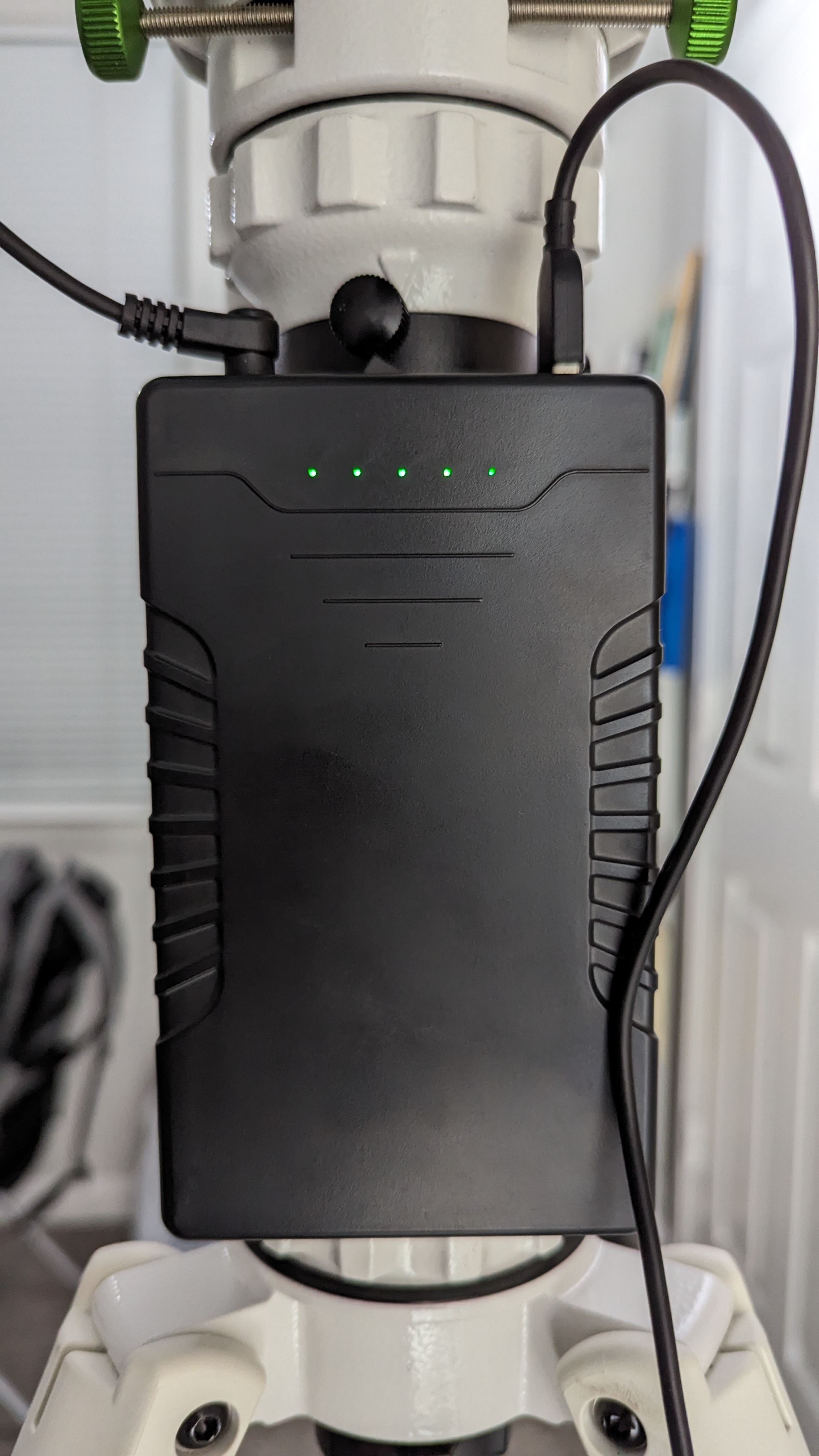
In the following weeks I completed the setup. The mount works with 12V DC, so I bought a 12V/5V power pack to power the mount and recharge the phone. I also bought a couple spare batteries and charger for the camera, and a telephone holder to attach it to the tripod.The phone I use for controlling the mount is an old one with no carrier that connects fine to the mount. No special speed or display capabilities are needed for the app to work properly, so that way I can keep my phone for other matters.
So this is it, my new rig in specs:
Telescope: Sky Watcher Evolux 62ED - 400 mm f/6.45
w/ Flattener/reducer 0.9X - 360 mm f/5.8
Mount: Sky Watcher Star Adventurer GTi with tripod
Camera: Canon EOS 250D (DSLR) unmodified - APSC sensor
Software: SynScan to control the mount, polar align, GOTO and to control the camera with the intervalometer
 |
| My first telescope and mount |
Federico Arribas